
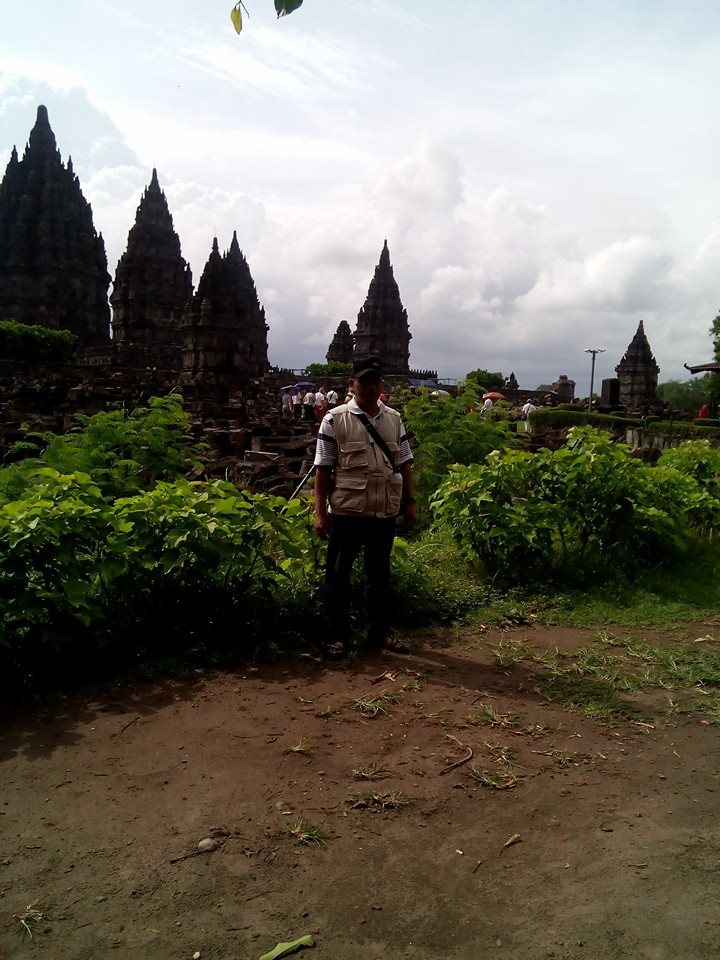
KANGJO.INFO, Yogyakarta. Prambanan Temple is one of the finest masterpieces ever created by ancient Javanese civilization. Standing majestically on the border of Yogyakarta and Central Java, Indonesia’s largest Hindu temple complex exudes a timeless charm. The beauty of its architecture, the delicacy of its carvings, and the legends surrounding it make Prambanan not only a tourist destination but also a symbol of the richness of Indonesian culture.
The author visited Prambanan Temple on Sunday, August 6, 2022, with a group of 12 members of the Joutomo family.
Stunning Architectural Splendor
Built in the 9th century by the Sanjaya Dynasty of the Ancient Mataram Kingdom, Prambanan Temple was designed with a Hindu divine concept that glorifies the Trimurti: Brahma, Vishnu, and Shiva. Among the hundreds of temples in the complex, the Shiva Temple stands tallest, reaching a height of 47 meters. Every corner of the building showcases the beauty of its symmetrical forms, orderly spatial layout, and the Hindu cosmological philosophy embedded in its structure.
Prambanan’s uniqueness lies not only in its grandeur but also in the detail of its carvings. The reliefs adorning the walls depict the epic story of the Ramayana, a blend of art, literature, and religion, conveyed through exquisite carving techniques. Through these reliefs, Javanese ancestors expressed their creativity and conveyed moral messages to future generations.
Harmonious Carvings Bring Stories to Life
Every relief on Prambanan Temple seems to have life. The movements of the Ramayana characters, their facial expressions, and even the details of their clothing are all carved with exquisite precision. Past artists successfully conveyed the dynamics of the scenes in hard andesite stone, a testament to their high technical and aesthetic skills.
In addition to the Ramayana story, carvings of mythological creatures, flora, and fauna enhance Prambanan’s visual beauty. These ornaments are not merely decoration, but also spiritual symbolism, depicting the balance of nature, life, and humanity’s relationship with the gods.
A Mysterious Story Enveloping Its Beauty
The beauty of Prambanan Temple is further enhanced by the legends inherent in its local culture. One of the most famous is the story of Roro Jonggrang, the beautiful princess believed to be the originator of the temple’s founding. According to folklore, she was cursed to turn to stone after rejecting Bandung Bondowoso’s proposal and demanding the construction of 1,000 temples in one night. This story adds a touch of romance and mystery to Prambanan, making visitors feel transported to another world as they explore the temple’s corridors.
Beyond the legends, many other mysteries contribute to its appeal, such as the construction techniques considered advanced for their time, the precise symmetry of the buildings, and the existence of small temples that have not been fully restored. All of these intrigue archaeologists and history buffs alike to this day.
A World Heritage Site That Continues to Burn
Designated as a UNESCO World Heritage Site in 1991, Prambanan is a global symbol of the glory of the Indonesian archipelago. Restoration and preservation efforts are ongoing so that future generations can enjoy the same splendor as thousands of years ago. The Ramayana ballet performance, regularly held in the Prambanan area, also serves as proof that art, culture, and history can blend harmoniously in one place.
Conclusion
“The Charm of Prambanan: Harmony of Carving Art and a Mysterious Story” is not just a title, but a concrete representation of the beauty and depth of meaning held by this temple. Prambanan is a space where art, history, mythology, and spirituality meet in harmony. To visit it is to follow the majestic footsteps left by our ancestors—traces that will continue to captivate all who come to see them. (kangjo)