KANGJO.INFO, Magelang, Central Java. Borobudur Temple is not just a stone structure, but a masterpiece that combines artistic beauty, architectural sophistication, and the spiritual depth of ancient Javanese society. Standing majestically in Magelang Regency, Central Java, the world’s largest Buddhist temple continues to radiate its charm, drawing millions of visitors from all over the world to witness its majesty that has endured for more than 12 centuries.
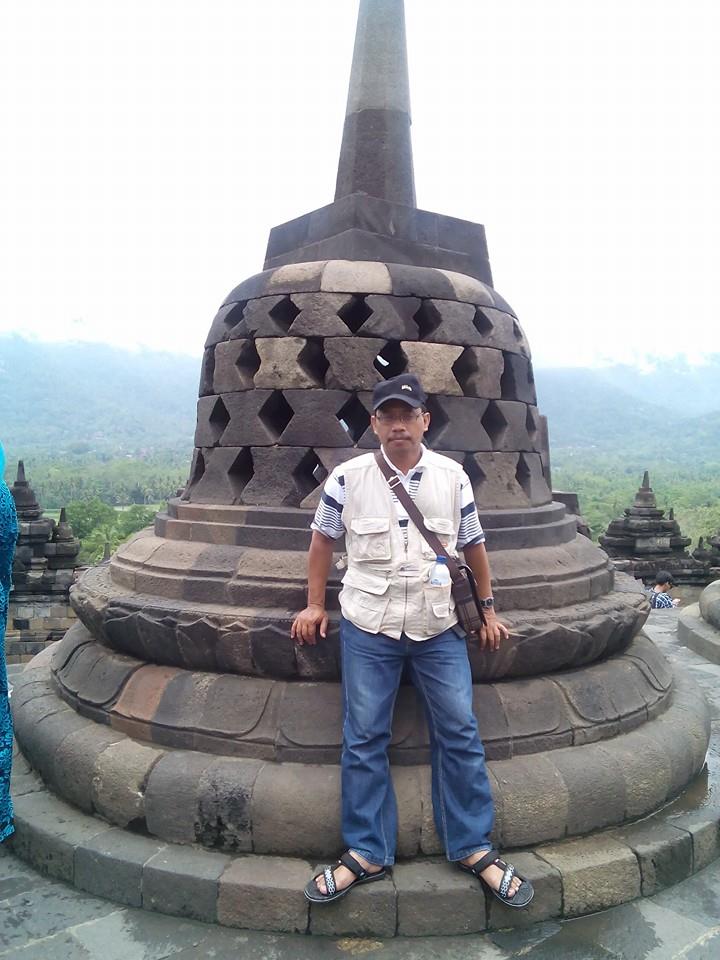
The author visited Borobudur Temple on Saturday, August 5, 2023, with a group of 12 members of the Joutomo family.
Historical Traces Behind the Splendor
Borobudur was built during the Syailendra Dynasty around the 8th to 9th centuries AD. Although no inscriptions definitively date its construction, archaeologists believe this temple represents the pinnacle of ancient Javanese civilization’s achievements in art, religion, and architectural engineering. Borobudur was then forgotten for centuries due to the eruption of Mount Merapi and changes in local beliefs.
It wasn’t until 1814 that Sir Thomas Stamford Raffles, then the British Governor-General of Java, “rediscovered” Borobudur and began the process of recording its location. Since then, conservation efforts have been ongoing, leading to its designation as a UNESCO World Heritage Site in 1991.
A World-Famous Architectural Masterpiece
Borobudur’s majesty lies in its structure and architectural details. This nine-story structure consists of six square terraces, three circular courtyards, and a main stupa towering at the summit. When viewed from above, Borobudur resembles a giant mandala—a symbol of the cosmos in Buddhist teachings.
Its construction consists of approximately two million andesite blocks, laid without cement, but interlocked using a precision dowel-mesh technique. The strength of this construction technique is evidenced by its resistance to earthquakes and weathering for over a thousand years.
Reliefs Telling the Story of a Life Path
One of Borobudur’s main attractions is its stunning reliefs. There are more than 2,600 relief panels depicting various moral teachings, the lives of ancient Javanese people, and the spiritual journey to enlightenment. These include:
Karmawibhangga: depicting the law of cause and effect.
Lalitavistara: the story of Siddhartha Gautama’s life.
Jataka and Avadana: moral stories and examples of goodness.
Gandavyuha: Sudhana’s journey in search of wisdom.
These reliefs are not only beautiful but also serve as valuable sources for historians in understanding the culture, technology, and lifestyles of past societies.
Spiritual Meaning in the Temple’s Structure
Each level of Borobudur holds profound philosophical significance. Starting from Kamadhatu (the realm of desire), ascending to Rupadhatu (the realm of form), and finally to the summit of Arupadhatu (the realm of formlessness). As you climb Borobudur’s steps, visitors are invited to embark on a spiritual journey toward enlightenment.
The silence of the upper courtyard, combined with the views of Mount Merapi and Mount Merbabu surrounding the temple, creates a peaceful atmosphere that makes anyone feel like they’re in a state of deep contemplation.
Borobudur from a Tourism and Conservation Perspective
Today, Borobudur is one of the most important cultural tourism destinations in Indonesia. Conservation programs are ongoing to maintain the stability of its structure and the preservation of its reliefs. The government and UNESCO regularly conduct research, monitoring, and restoration to ensure Borobudur remains sustainable for future generations.
Cultural tourism activities such as the Borobudur Sunrise, arts festivals, and historical education also serve as additional attractions, strengthening Borobudur’s role as a national tourism and cultural icon.
Borobudur Temple is a magnificent heritage
Borobudur Temple is a magnificent heritage that not only testifies to the glory of ancient Javanese civilization but also bears witness to the history of the Indonesian archipelago. Its architectural beauty, rich reliefs, and philosophical meanings make Borobudur a destination that is not only visually appealing but also deeply moving.
Exploring Borobudur means treading a timeless spiritual, historical, and cultural trail—a valuable experience in Java that always beckons. (kangjo)